
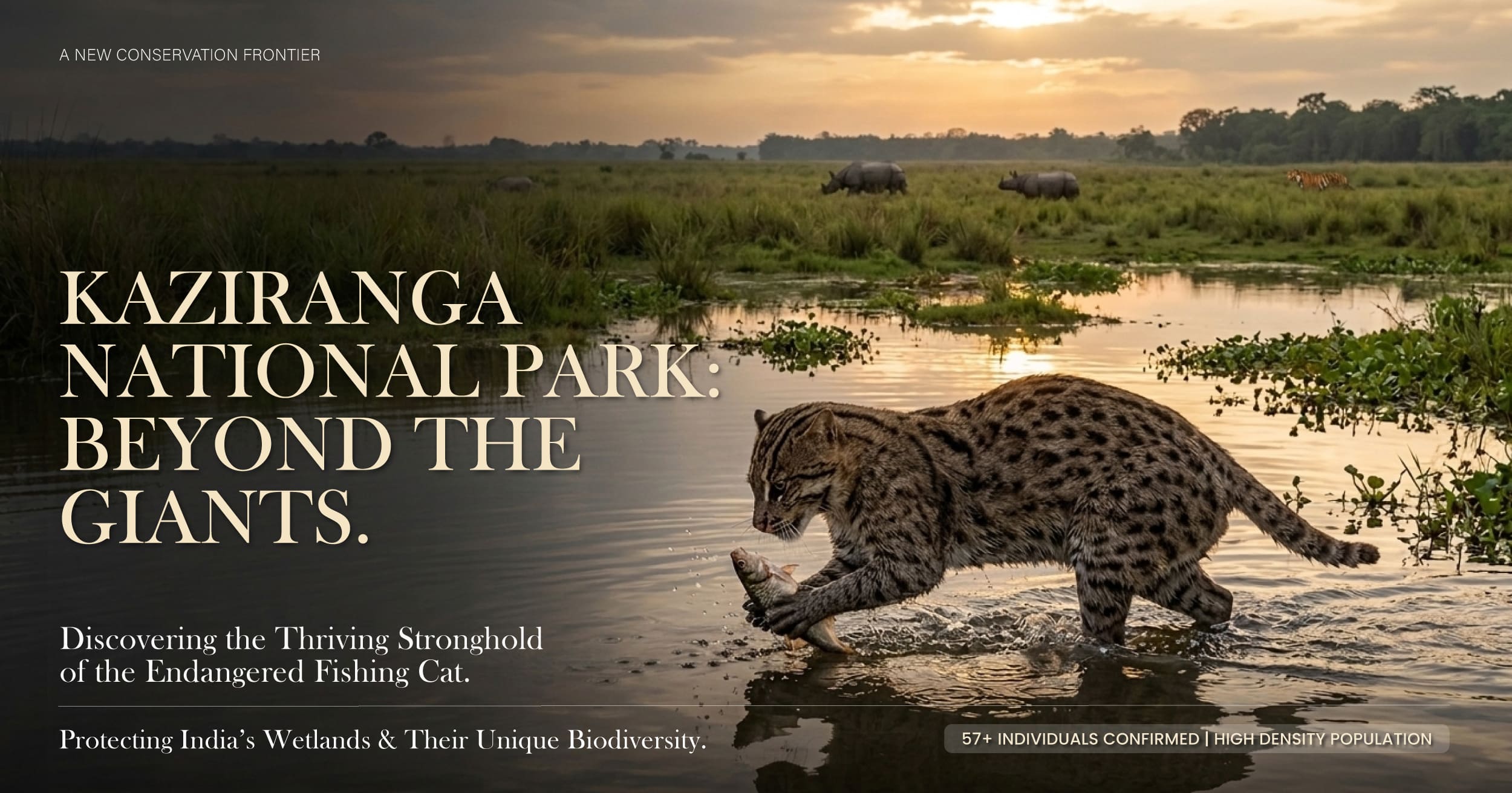
Fishing Cats In Kaziranga National Park
Kaziranga National Park is in the state of Assam, India. It is one of the most important protected areas in the country. For many years, it has been known worldwide for its large number of one-horned rhinoceroses and a strong population of tigers. These animals have built the park’s image for a long time. The park has wide floodplains and lowland. It contains wetlands, tall grasslands, marsh areas, and many natural water bodies.
The Brahmaputra River flows beside the park and changes its land every monsoon. Flooding happens every year. These floods bring fresh soil, increase soil fertility, refill wetlands, and reshape the land. This natural cycle keeps the ecosystem healthy and productive. Now, experts also recognize the park as an important home for fishing cats, showing its rich biodiversity.
Fishing Cats Found In Kaziranga National Park
A recent scientific study provided important information about fishing cats in Kaziranga National Park. For the first time, researchers carried out a systematic study to estimate the fishing cat population inside the park. Earlier, there was very little clear data about their numbers in this area.
The researchers used camera traps to collect information. These cameras were originally placed in different parts of the park to monitor tiger movements. While examining the images, scientists noticed several clear photographs of fishing cats. After careful analysis of the images, they confirmed at least 57 individual fishing cats across more than 450 square kilometres of floodplain habitat.
This number is very important. It is one of the highest recorded counts of fishing cats in any freshwater ecosystem in India. The actual number may be higher because not all animals are always captured by cameras. However, the confirmed count gives a reliable starting point. It provides a scientific baseline that can be used for future monitoring, population studies, and conservation planning.
This discovery changes how people view Kaziranga National Park. It is not only a place for large animals like rhinoceroses and tigers. It is also an important habitat for smaller carnivores that depend on wetlands for survival. The park plays a key role in protecting species that are less visible but equally important.
About The Fishing Cat
The fishing cat is an endangered species of wild cat. This species of wild cat has unique physical and behavioral features. This cat species is nocturnal. During the day, this cat sleeps in dense vegetation. The fishing cat possesses partially webbed feet.
This helps the cat to move easily in water. The body of this cat is well-built and muscular. This cat possesses good swimming abilities. Unlike other small wild cat species, the fishing cat is associated with water-based habitats. Wetlands are essential for the survival of this cat.
Its main diet includes fish, amphibians, and other small aquatic animals. It hunts in shallow water areas, often near the edges of ponds, rivers, and marshes. It waits carefully and catches prey with quick movements. Because it depends heavily on freshwater systems, any damage to wetlands directly affects their survival. Without stable and clean wetland habitats, fishing cats cannot maintain healthy populations.
Threats To Fishing Cats In Other Regions
Fishing cats are found in parts of South Asia and Southeast Asia. However, their population is decreasing in many areas. The species is under pressure due to several human-related activities.
The biggest threat to fishing cats is habitat loss. Wetlands are often drained or filled for farming, housing, roads, and other infrastructure projects. When wetlands are destroyed, fishing cats lose their main source of food and shelter. Once wetlands are changed for development, they rarely return to their original natural condition.
Water pollution is another serious problem. Industrial waste, agricultural chemicals, sewage discharge, and plastic waste reduce water quality. Poor water quality affects fish and amphibian populations. This reduces the food supply for fishing cats.
In some places, fishing cats are also hunted or killed due to conflict with humans. When wetlands shrink, these animals may move closer to villages or farms in search of food. This can lead to misunderstandings and conflict. Because fishing cats depend strongly on wetland ecosystems, any disturbance in these habitats quickly leads to a decline in their numbers.
Why Kaziranga National Park Is Important For Fishing Cats
Kaziranga National Park offers different types of habitats that are favorable for fishing cats. There are large wet alluvial grasslands found within the park. There are wetlands, also referred to as beels, that offer a consistent water supply and fish. There are woodlands that offer protection for breeding.
These types of habitats allow the full life cycle of the fishing cat. These offer space for the fishing cat to hunt, breed, and raise young. There is limited human interference, unlike many wetland sites. This is important because fishing cats require places with limited human interference.
Through events such as Fishing Cat Day, field surveys, and awareness programs, the importance of Kaziranga National Park for the fishing cat species has been highlighted. Today, the park is considered a stronghold for the fishing cat species. This conclusion has not been reached on the basis of an assumption, but on the basis of facts. In fact, fishing cats are ecological indicators.
Their presence indicates that the wetland ecosystem is functioning properly. A healthy population of any predator species indicates that there is enough prey available for them, and the freshwater ecosystem is healthy.
Wetland Conservation And Tourism In Kaziranga
Wetlands are very delicate areas that require proper care. Climate change may alter the amount of rainfall, river flow, and intensity of floods in the future. If the level of water or flood patterns changes in the future, the wetland areas may also change. Fishing cats live in these areas to hunt their food and find shelter.
Climate change affects their habitats in the future. Another factor that affects these areas is human activity around these protected areas. Encroachment, pollution, and construction activities harm these areas in India. For the proper preservation of these areas, proper planning and cooperation between forest staff and people are required.
Every species, including the less popular ones, needs protection under wildlife protection schemes. Although the rhinoceros and tiger attract worldwide attention, the fishing cat also needs protection for the maintenance of biodiversity.
There can be no biodiversity if all the species are not protected together. Tourism plays a vital role in the success of Kaziranga National Park. Tourists from different countries, including India, make Kaziranga bookings for the wildlife experience. Many tourists make advance bookings for Kaziranga before they arrive.


(0) Comments: