
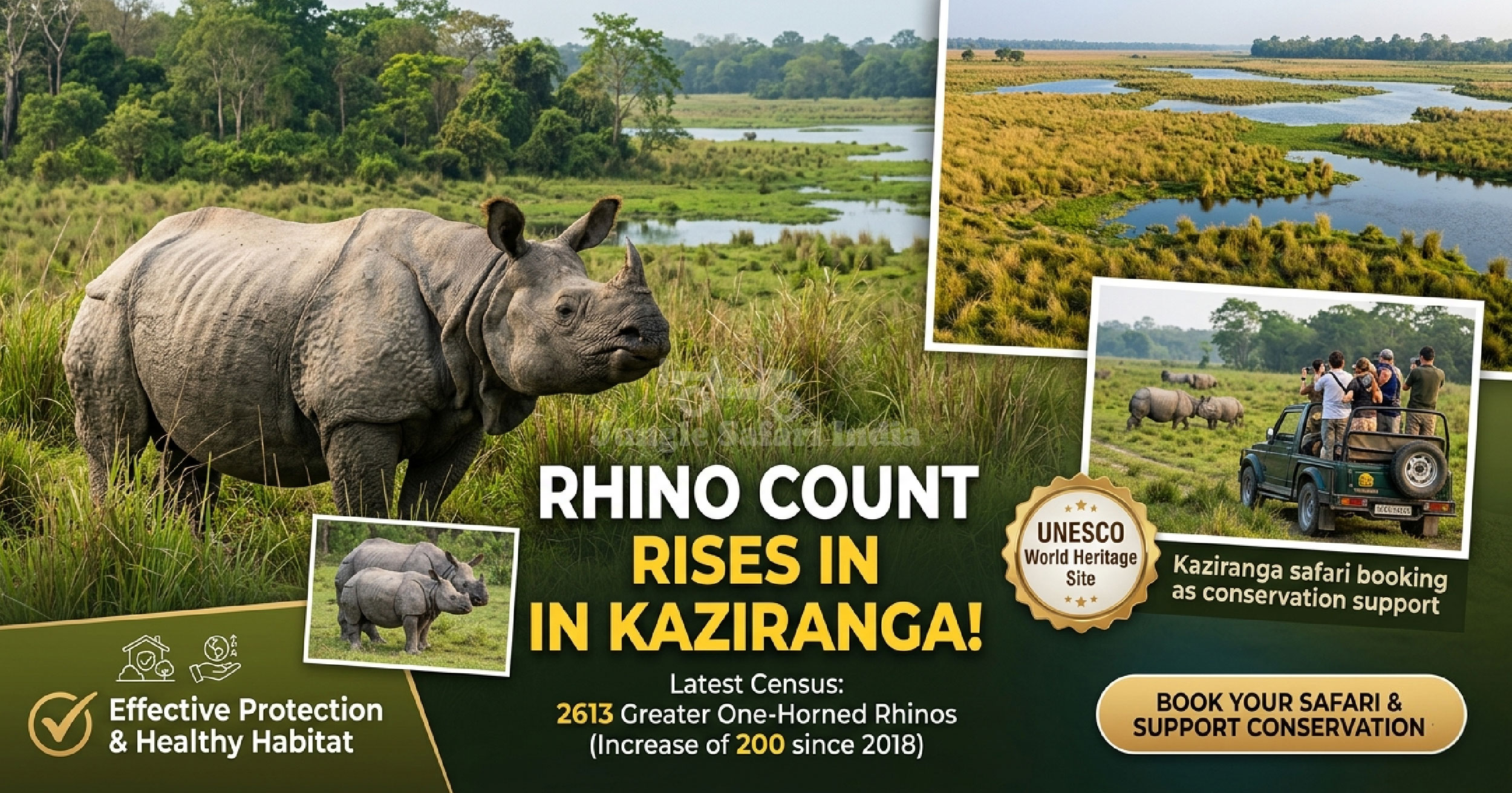
Rhino Count Rises In Kaziranga National Park
Kaziranga National Park is a renowned wildlife park located in the Indian state of Assam. It is a UNESCO World Heritage Site, covering an area of around 1,000 square kilometers. Kaziranga National Park is the primary habitat of the endangered species, the one-horned rhinos. The national park features lush green forests, high grasslands, and water bodies, which are important for the survival of various animal species.
On March 29, the authorities confirmed that the number of one-horned rhinos has hit its peak. This growth in numbers is proof of the effectiveness of the protective measures of the park. This also proves that the plants and animals in the park are very healthy.
Latest Rhino Population Data
According to the latest census, the overall population of rhinos present in Kaziranga National Park stands at 2,613, which is higher compared to the previous census and indicates an increase in their numbers. Out of these 2,613 rhinos, some are mature rhinos, and the rest are young rhinos.
The rise in the number of rhinos is due to many years of dedicated work by forest officers, wildlife specialists, and the government. The measures include constant monitoring of the creatures, protection against any threat to their safety, and good management of their natural habitat.
The officials in charge of the park have ensured that the environment is healthy enough to support the rhinos. As a result, the animals lead comfortable lives, and their numbers continue to rise. The consistent growth of their population is a good indication of the future. It shows that the species will thrive.
Comparison With Previous Count
According to the statistics of 2018, the number of rhinos at Kaziranga National Park and Tiger Reserve was 2,413. Today, the rhinos have increased in number to 2,613. This clearly shows that the number of rhinos increased by 200 within a period of four years.
Such a development should be viewed as positive since it shows the proper execution of conservation programs for the area. The slow yet gradual increase in numbers indicates that the environment at present is very stable and important for these animals.
Previously, the one-horned rhinoceros was endangered for many years. However, due to this good management, this number has been improving gradually. Efforts such as anti-poaching measures, conserving the natural habitats, and monitoring the rhinos have proved very effective.
Through these efforts, the rhinos' threats have been minimized, and they are able to move around freely without fear. Their population growth is an indication that they are healthy and capable of reproducing. This is because of the constant effort that has proved successful.
Detailed Breakdown Of Rhino Population
The total number of 2,613 rhinos has been carefully studied and divided into different groups. This helps officials understand the population in a better way. Out of the total number, there are 866 male rhinos and 1,049 female rhinos. There are also 273 rhinos whose gender could not be identified during the counting process.
In addition to this, there are 279 juveniles. These are young rhinos that are still growing. There are also 146 calves, which are very young rhinos. This detailed information is very useful for planning and management.
The number of female rhinos is higher than the number of males. This is good for reproduction because it increases the chances of more births in the future. The presence of many juveniles and calves shows that breeding is happening regularly.
These numbers show that the population is not only growing but also healthy. Park authorities can use this data to make better plans. They can improve breeding programs, manage habitats properly, and make sure that rhinos stay safe. This detailed study is very important for the long-term survival of the species.
How The Census Was Done
The rhino counting process was conducted for a total of three days, between the dates of March 26th and March 28th. The rhino counting involved a well-trained team of people. This team comprised forest guards, wildlife experts, and other personnel. Rhino counting was performed very carefully to ensure accuracy.
There were two main types of methods employed in the process. The first type of methodology was that of the ground survey. In this case, groups went around various regions of the national park and conducted a headcount of the rhinos. The second technique involved conducting aerial surveys, which involved using helicopters to view places that are hard to access by walking on foot.
This combination will ensure that any errors are avoided and the results will be more precise. There are certain sections of the park that are difficult to reach, making an aerial survey more practical. Ground surveys enable a closer inspection. This census is highly significant because it will help officials determine the health of the rhinos. Furthermore, it will enable the authorities to come up with appropriate plans regarding their protection and food supply.
Official Statement And Importance
The Divisional Forest Officer of Kaziranga National Park, Ramesh Gogoi, provided information about the number of rhinos in the park. According to him, there are 2,613 rhinos in the park now. It proves the effectiveness of the conservation activities conducted in Kaziranga National Park for preserving rhinos.
The conservation activities included strict anti-poaching measures, effective habitat management, and community participation. The growing number of rhinos is not only important to the national park itself but also important to wildlife conservation around the world.
The one-horned rhino plays an essential part in balancing the ecological system. Every organism has a place in nature, and the rhino also does. The successful story of the Kaziranga National Park serves as a model for other wildlife sanctuaries. This means that with adequate measures and efforts, endangered species can be saved.
How Visitors Can Help With Conservation
Support for the conservation efforts at Kaziranga National Park is also possible through different methods. One simple method through which visitors can help with conservation at the park involves making a Kaziranga safari booking.
Visitors have to make a payment in order to book safaris inside the park. The money collected in such transactions is used for various purposes related to the management and conservation of the park. Safari tours also enable tourists to view the rhinos and other species of animals in their natural habitat and surroundings.
The tourists can get an opportunity to learn about wildlife and understand the importance of conserving it. When making a Kaziranga safari booking, they will be aiding in protecting the rhinos.
Related Post
No related blogs available at the moment.
(0) Comments: