
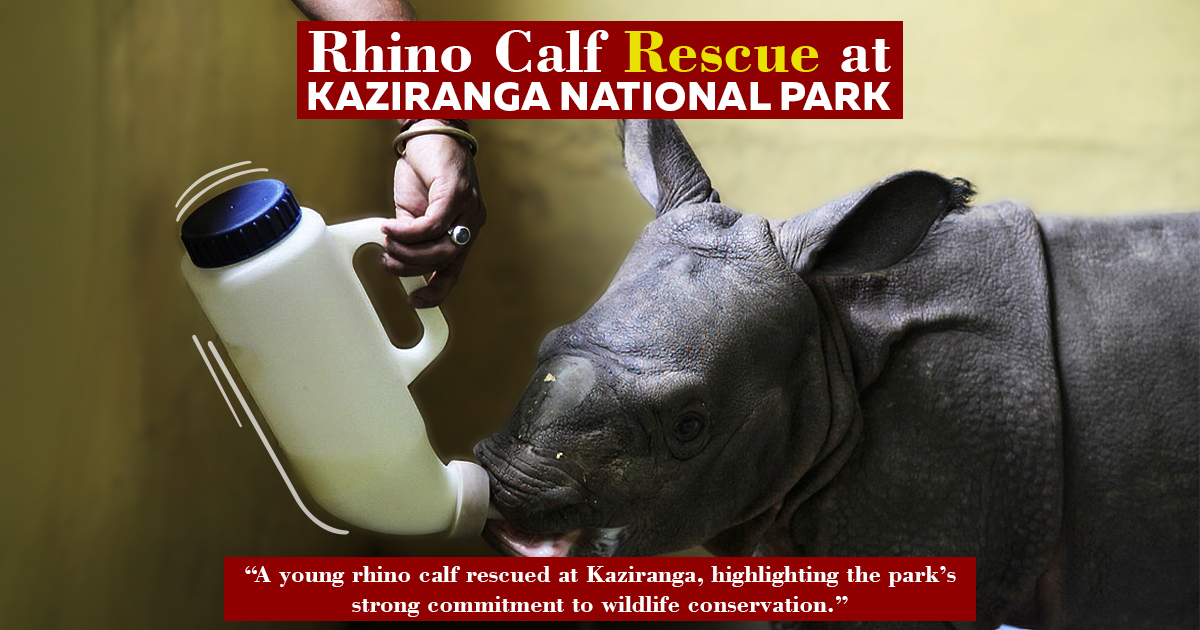
Rhino Calf Rescue At Kaziranga National Park
Kaziranga National Park & Tiger Reserve in Assam, India, stands as one of the world's most essential wildlife conservation areas. The park protects the greater one-horned rhinoceros, which has its largest population in this area. The park protects many endangered species through its various environments that include grasslands, wetlands, and forests.
Recently, the Burapahar range rescue mission discovered a male rhino calf, which appeared weak and young and was found alone in the area. The officials from the forest department took immediate action because the situation became critical after they discovered the calf without its mother.
Kaziranga National Park serves as both a tourist destination and a sanctuary for protecting wildlife. Learning about such rescues encourages more people to support conservation through Kaziranga safari booking.
How the Rhino Calf Was Found
On the evening of January 21, forest staff found a lone rhino calf in the Sarali area of the Burapahar range inside Kaziranga National Park. The calf was very young and was not seen with its mother. This caused serious concern among forest officials and wildlife experts.
The information was confirmed by Dr Sonali Ghosh, Field Director of Kaziranga National Park & Tiger Reserve. She said the calf was alone and unattended. This is very dangerous for such a young rhino. The absence of a mother causes a calf to become weak, sick, and vulnerable to injuries and attacks from other wildlife.
The forest teams secured the area that contained the calf. The observers maintained their distance from him while they monitored his movements. His health, movement, and behavior were checked again and again. The first plan was to find the mother rhino and reunite her with the calf.
The forest staff did not touch the calf immediately. The team spent time in the area to watch for the mother's return. This is the best and safest method in wildlife rescue. Reuniting a calf with its mother is always the top priority.
Search Operation to Find the Mother Rhino
A large search operation started under the leadership of the Divisional Forest Officer (DFO), EAWL Division. Many forest teams joined the operation. Both modern technology and traditional tracking methods were used.
Department elephants were sent into tall grass and forest areas. These elephants helped forest staff move safely and see over thick vegetation. Thermal drones were also used from the air. These drones can detect body heat and help find large animals like rhinos.
Frontline forest staff walked long distances and searched many parts of the forest. They worked in groups and followed a planned route. The search covered a wide area of the Burapahar range inside Kaziranga National Park.
The search continued for more than 24 hours. During this time, a veterinary team stayed near the calf. The team included Dr Bhaskar Choudhury, Dr Mohit Nyol, and Dr Saurobh Borgohain. They checked the calf’s health, gave him water, and watched him all the time. They made sure he was safe, calm, and protected.
Even after long efforts, the mother rhino could not be found. When no mother appeared, forest officials understood that the calf could not survive alone. They then prepared for a rescue operation to save his life.
Rescue and Transfer to CWRC
The safety of the calf became the main goal. After careful planning, officials decided to rescue him. The operation was done on January 22 at around 4 pm.
Forest staff carefully secured the calf. They followed strict wildlife safety rules. The calf was handled gently to prevent fear and injury. His health was checked before transport and also during the journey.
The calf was moved from the Burapahar range of Kaziranga National Park to CWRC. Monitoring continued throughout the journey. Forest staff and veterinarians made sure the calf stayed stable and calm.
CWRC became the calf’s new temporary home. At CWRC, he will receive medical care, proper nutrition, and long-term rehabilitation support. Wildlife experts will prepare him for a healthy future.
This rescue marked the beginning of a guided recovery process. The main aim is to raise the calf safely and, when possible, return him to the wild.
About CWRC and Its Work with Wildlife
The Centre for Wildlife Rehabilitation and Conservation (CWRC) was started in 2002. It is a joint project of the Assam Forest Department, the Wildlife Trust of India (WTI), and the International Fund for Animal Welfare (IFAW).
CWRC plays a very important role in wildlife protection in Northeast India. The center rescues animals affected by floods, road accidents, forest fires, and human-wildlife conflict. It treats injured wildlife, raises orphaned animals, and releases healthy animals back into forests.
Over the years, CWRC has rescued more than 7,397 animals from 357 different species. Out of these, about 4,490 animals were successfully treated and released back into the wild.
CWRC is well known for its work with rhinos. The center has hand-raised 25 rhino calves. Out of these, 23 were released into Manas National Park. Two rhinos were earlier returned to Kaziranga National Park.
At present, CWRC is caring for three rhino calves. On January 20, two male rhinos were successfully moved back to Kaziranga National Park. This was another important success in rhino conservation.
These numbers show that CWRC has long experience in wildlife rescue, animal care, and conservation work.
Rhino Translocation, Experts Involved, and Conservation Efforts
All recent rhino relocations followed strict wildlife conservation laws. The Chief Wildlife Warden of Assam approved the process under the Wildlife (Protection) Act.
A special committee was created to find safe places for rhinos. The areas were checked carefully because they needed to have proper animal food supplies, water resources, and protective measures for wildlife.
Kaziranga National Park established pre-release enclosures to host the rhinos. The enclosures provided the animals with a wild experience, which taught them how to hunt and explore their surroundings.
The veterinary team, which included Dr. Bhaskar Choudhury, Dr. Sourabh Buragohain, Dr. Mohit Nyal, and Dr. Mehdi, worked with trained animal keepers. They provided the rhinos with regular health checks, proper dietary needs, and security measures.
The operation was managed by Dr. Sonali Ghosh and Arun Vignesh CS with their team of experts. The team dedicated their efforts to protecting animal welfare and preserving rhinos for future generations.
The conservation work at Kaziranga National Park demonstrates that every rhino rescue operation contributes to ecosystem protection. The process of Kaziranga safari booking serves as a vital part that sustains this essential work.

(0) Comments: